

The Lady is a riveting film with commanding performances from Michelle Yeoh (playing Suu Kyi) and the supporting cast. The production quality blew me away, both from the cinematography, which features the lush landscapes of Burma (now known as Myanmar), to the thrilling soundtrack which mixes orchestral strings with nods to Asian instruments and musical progressions. I was also fascinated to see examples of different cultures within Burma, from the orange-robed monks to different tribal groups with faces lined and dotted with tattoos. The movie doesn’t dive into these distinctions or who each group is, but instead presents what feels like a cross-section of culture as part of the natural flow of the larger story.
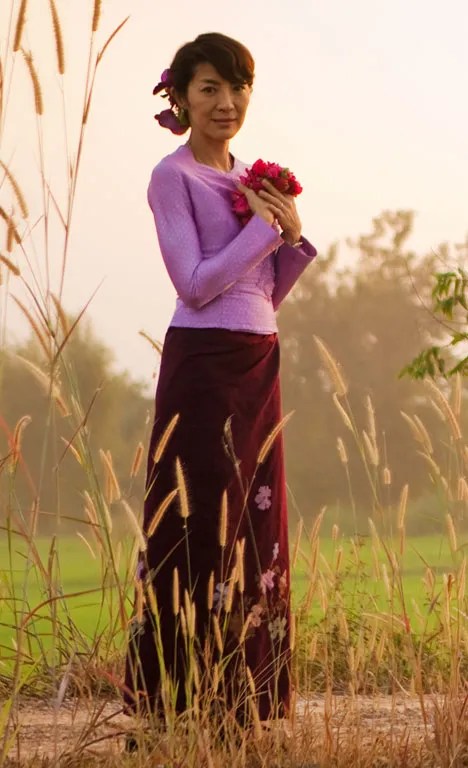
According to IMDb, Yeoh spent hours studying Suu Kyi’s voice and learning Burmese for this role, and the attention to detail shows and gives this film an unusual authenticity for a movie that is essentially about current events and which could easily fall apart if not well-researched. One tiny detail that I enjoyed throughout the movie was the orchids that Suu Kyi wears in her hair in almost every scene; in fact, she apparently has an orchid that was named after her, perhaps due to her prolific use of the flower in her sartorial ensembles.
Unlike most movies “based on a true story,” a quick Internet search actually confirms all the main plot elements of The Lady. Perhaps what makes this film adaptation of Suu Kyi’s story especially touching is its portrayal of her relationship with her family and the pain and struggles she must have faced over the decades as she had to chose between being with them in England versus staying in Burma to fight for democracy, when even one flight out of Burma to see her husband or sons could prove a closed door to Burma forever.
What amazes me is how, even after the pain her family suffered at the hands of the oppressive military regime in Burma and the years she spent in the U.K. building a life and family, Suu Kyi never lost her love for her country and passion for the cause of her people. At least how the film portrays it, Suu Kyi doesn’t return to Burma to start a political campaign or to become its leader, and when she does become the head of the fight for democracy, she doesn’t actively promote herself but the democratic election process itself. While I suspect parts of the story gloss over Suu Kyi’s flaws (and the movie was released prior to the events involving the Rohingya), I find it hard to imagine that pursuit of political power would have tempted a woman with the family and career of Suu Kyi and a home in the U.K. to brave the deprivations, danger, and heartache that the fight for Burma’s democracy demanded—with no guarantee of success, even to this day.
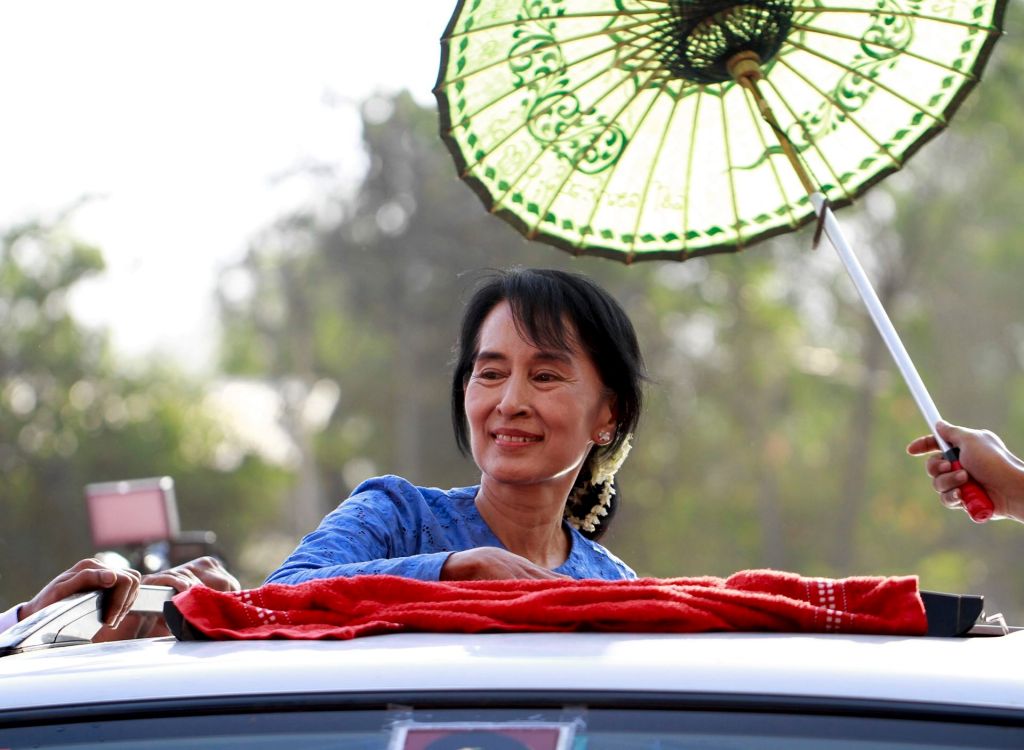
The story, which ends prior to the film’s 2011 release, remains hauntingly timely in light of the more recent 2021 military coup that overthrew the democratic government Suu Kyi helped champion and that has placed Suu Kyi in prison, possibly for life.
I won’t dive deep into the controversy around Aung San Suu Kyi and her response to the Rohingya persecution and genocide as I don’t know enough to offer much insight. But I can say that this movie is a humbling yet inspiring reminder about what the fight for democracy can demand and what people are willing to do in answer to its call. I think it’s also a reminder that the people we admire are humans too and will make mistakes, but for those of us not in the arena, we shouldn’t be too hasty to judge situations we may not entirely understand or to devalue the courage, sacrifice, or achievements of others, even when they fall. Also, just as we can’t put our faith in individuals, neither can we put our faith in any system or government, even democracy. For democracy can oppress, just as totalitarianism can—which may well explain Burma and Suu Kyi’s treatment of minorities like the Rohingya in the years following this film’s narrative.
One of the greatest merits of The Lady is that the film makes Burma’s story more understandable and accessible for wider audiences and will hopefully spark further research, reflection, and appreciation for the freedoms we take for granted in the West. And also more prayer for the people who are still “yearning to breathe free” (Lazarus).
Works Cited
Lazarus, Emma. “The New Colossus.” Poetry Foundation, http://www.poetryfoundation.org/poems/46550/the-new-colossus.
Discover more from Worthwhile Words
Subscribe to get the latest posts sent to your email.

Pingback: How Disney’s “American Born Chinese” Flips the Script | Flint and Bone's Comic Reviews