

Books and blogs abound with tree metaphors for the Christian life. Yet, both old and new ground needs regular tilling, so whether these six ideas are novel or not, I hope they prove useful.
1. Roots bear fruit.
Being rooted in the Gospel leads to the fruit of the Gospel. That’s why Christians need to understand, dwell on, live in, and live out the Gospel in every aspect of life, not merely their personal walk but especially as part of evangelism. What we are rooted in nurtures the rest of us and influences the kind and quantity of fruit we bear. Only good roots can bear good fruit.
2. Fruit spreads seeds.
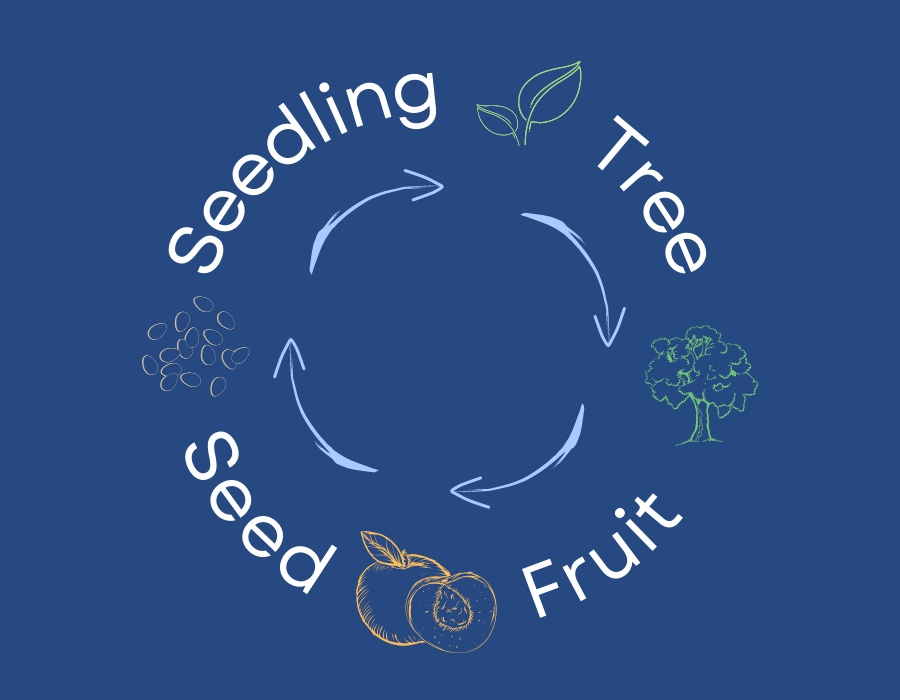
Bearing fruit spreads the seeds of the Gospel. Like ordinary fruit such as apples or peaches, our fruit also carries seeds: the seeds of the Gospel. And God uses his people’s fruit to scatter these seeds for others. In this way, our faithful following of Christ becomes a faithful witness for Christ to others.
3. Too much of something good can be bad.
Fertilizer, water, and sunshine are vital for the growth of any plant, but too much of any of these ingredients for success—especially given too soon—can kill a plant instead of helping it grow. For evangelism, I think this can help us understand the need to pace ourselves when supporting people who are beginning their Christian walk. Our enthusiasm leads us to recommend lots of books and topics. And their enthusiasm can lead to burnout or to harmful results—for instance, the “Cage stage” in Calvinist circles, where people new to Calvinism are so excited they want to hit everyone else on the head with their newfound knowledge.
Instead of showering everyone we meet with all the information we can think of, we should get to know each person and his or her individual needs before giving a data dump of books, blog, pastors, or podcasts. We should be enthusiastic, yes, but our enthusiasm should be tempered with wisdom so we can nurture instead of overwhelm.
The following three concepts come directly from my own experience growing trees. Before I jump in, I want to mention one thing that’s at the heart of these six ideas, which is part of why I’m putting it at the center of this post. Through my own tree-planting and gardening experience, I have witnessed how miraculous God’s creation is and been humbled each time with reminders that only God can make a plant grow. He uses people like me to sow, water, and nourish plants and seeds, but without his life-giving intervention, none of my efforts would succeed. Gardening thus teaches us humility and hope, to plant and to pray and to always remember our reliance on God.
In the same way, evangelism is something we want to be able to control; we want to see trees, flowers, and fruit right away, but God reminds us again and again that only by the Holy Spirit’s work will our efforts come to fruition, so we must be perseverant, prayerful, and above all patient, which leads me to the next point.
4. Seeds don’t sprout on our timetable.
Seeds don’t always sprout on our timetable. In fact, they rarely do in my experience. Right now, I’m waiting for my marigolds and forget-me-nots to appear and worrying that I did something wrong—too early, too deep, not enough water, too much water, not enough sun, too much…the list goes on. In evangelism, we must be patient and realize that not every seed we scatter will sprout, and even the ones that do sprout may take a while, even years.
The ultimate example I’ve experienced of seeds working on a different timetable was when I planted loquat seeds. Loquats are trees that bear orange melon-like fruit similar to kumquats, but smaller. I had carefully saved six seeds from my grandmother’s loquat tree and planted them in a pot on my back porch. Months passed, and they didn’t sprout (story continued below).
5. Patient watering can bear unexpected fruit.
Patient watering can bear unexpected fruit, which isn’t always from the seeds you planted. The seeds we plant when we witness to others may never sprout in our lifetime or during the time that we know that person. Likewise, we may help water and see the result of other evangelists’ work, and our work may be continued by others well after a person passes out of our life. In fact, when the Corinthian church began arguing about which evangelist they followed—Apollos or Paul—, Paul admonished them with this very idea, writing:
“What then is Apollos? What is Paul? Servants through whom you believed, as the Lord assigned to each. I planted, Apollos watered, but God gave the growth. So neither he who plants nor he who waters is anything, but only God who gives the growth. He who plants and he who waters are one, and each will receive his wages according to his labor. For we are God’s fellow workers. You are God’s field, God’s building.”
1 Corinthian 3:5–9
Back to my tree story, I watered my loquat seeds regularly, and something sprouted that didn’t appear to be a weed, so I let it grow. Soon, I identified the seedling was not a loquat but a red maple (pictured above). I let it grow and continued watering it, hoping my loquats would still make an appearance but nevertheless excited to have produced at least one tree from the pot—even if it wasn’t on purpose.
6. Unintentional intervention can be the catalyst for growth.
The unintentional intervention of another can be the catalyst for a seed to sprout. Like I mentioned in the point above, we don’t always see the end of our efforts. Unexpected acts (“accidents”) of providence are often what bring about growth from seeds we sowed.
About a year after I planted the six loquat seeds, my red maple towered several feet over its pot, trunk bending lithely like a flagpole and leaves fluttering green. One evening, my mother was watering her plants on the back porch with the garden hose, and she accidentally caught my red maple with the hose and knocked it over. Setting the pot upright, maple unharmed, she noticed several large seeds in the spilled soil on the ground. She picked them up and realized they were my unsprouted loquat seeds, which had somehow not decayed after a year of water and sunshine. My mother returned the seeds to the pot and covered them up. Within days, a tiny sprout appeared near the base of the red maple. Not a weed, not a maple, but the long-awaited loquat tree.
Works Cited
The Holy Bible, English Standard Version. Wheaton, Illinois: Crossway Bibles, 2001. Print.
Discover more from Worthwhile Words
Subscribe to get the latest posts sent to your email.

Quick update: I’m excited to share that as of this evening, my first forget-me-not flower seeds have sprouted!
LikeLike
Pingback: Hope Springs – Worthwhile Words