

In one of the most famous English-language stories of all time, you’ll find a scene where two characters are moldering away in a dungeon, guarded by a ferocious giant. They got into this predicament because they left the path, which, as anyone who has read a children’s book or fairy tale knows, is always a bad idea. So you might be thinking the moral to this story is that you shouldn’t stray from the path, or try to take shortcuts, or whatever it was they were doing.
But here’s the real clincher. One day, when they’re talking in the dungeon, one of the prisoners reaches into his pocket and pulls out the key. Not a key, the key to the dungeon door. “Lookee here,” he says (to paraphrase him), “I had the key to the door in my pocket all along. We could have escaped at any point during the last few weeks if I had just realized this.” And so they proceed to escape.
Now, the moral of the story appears to have shifted from don’t stray from the path to don’t be stupid.
But here’s what you don’t know: the giant’s name was Despair, the dungeon was in the bowels of Doubting Castle, the key was Promise, and the two prisoners were Christian and his friend Hopeful. You guessed it. This book is John Bunyan’s allegory Pilgrim’s Progress, and the moral to the story is not don’t stray from the path and don’t be stupid (although those might be secondary morals). The moral is that we can be just as dumb as these two—well not exactly, but let me explain.
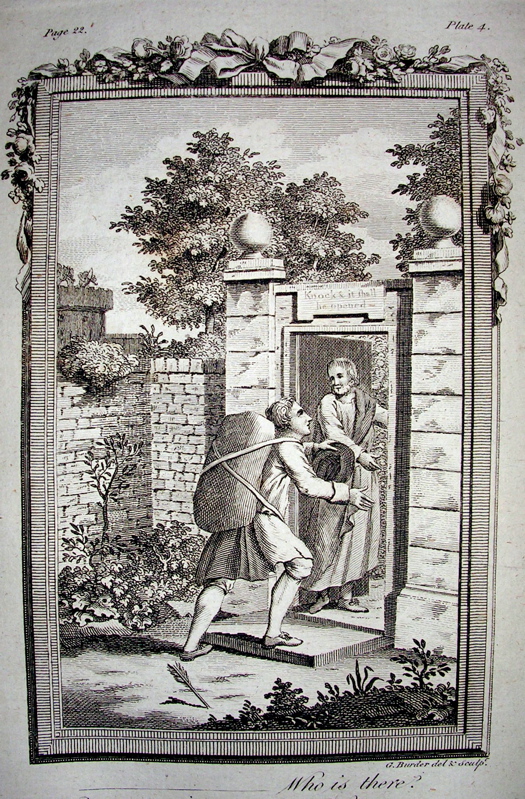
Like Christian and Hopeful, we get led astray by despair and get trapped by doubts, and even when we have the key to free us, we forget we have it. And this isn’t some ordinary key, it’s a promise, the Promise. The skeleton key to Life that, when used with faith, will unpick the doors to all the dungeons we get trapped in.
But what is this Promise? Bunyan’s simplicity allows for the complexity of the answer. Could the promise be “I will never leave you nor forsake you” (Heb. 13:5), or “for those who love God all things work together for good, for those who are called according to his purpose” (Rom. 8:28), or “Come to me, all who labor and are heavy laden, and I will give you rest,” or “For I am sure that neither death nor life, nor angels nor rulers, nor things present nor things to come, nor powers, nor height nor depth, nor anything else in all creation, will be able to separate us from the love of God in Christ Jesus our Lord” (Rom. 8:38–39), or “Believe in the Lord Jesus, and you will be saved” (Acts 16:31)? The list goes on, but I think the answer is yes. The key Christian pulled out was all these promises, and more. Paul writes in 2 Cor. 1:19–20, “For the Son of God, Jesus Christ…was not Yes and No, but in him it is always Yes. For all the promises of God find their Yes in him. That is why it is through him that we utter our Amen to God for his glory.”
Like Christian, we have this Promise too, hidden in our hearts. But let’s not bury it away or forget about it. Let us rejoice in it, and use it, especially when the road darkens and when we can’t see a way out. When despair is ready to knock us down with a cudgel and throw us into a prison of doubts. Let us make God’s Word, his promises, “a lamp to my feet and a light to my path” (Ps. 119:105). Let us dwell on the character of God, and thus be reminded of his faithfulness and his promises:
“With the merciful you show yourself merciful;
with the blameless man you show yourself blameless;
with the purified you show yourself pure;
and with the crooked you make yourself seem tortuous.
For you save a humble people,
but the haughty eyes you bring down.
For it is you who light my lamp;
the Lord my God lightens my darkness.
For by you I can run against a troop,
and by my God I can leap over a wall.
This God—his way is perfect;
the word of the Lord proves true;
he is a shield for all those who take refuge in him.”
—Psalm 18:25–30
God’s Word is powerful. It is a sword (Eph. 6:17; Heb. 4:12). It is a lamp (Ps. 119:105). It is the true light; it is Christ (John 1:1–18). It reminds us of the LORD’s goodness and truth, faithfulness and mercy. And the promises it holds for God’s people are, as Bunyan eloquently illustrated, the skeleton key for Life.
So the popular saying shouldn’t be “when life closes a door, God opens a window,” but rather “when we get trapped by sin or doubt, God has already given us the key to get out.” As Paul reminds us in 1 Cor. 10:13, “No temptation has overtaken you that is not common to man. God is faithful, and he will not let you be tempted beyond your ability, but with the temptation he will also provide the way of escape, that you may be able to endure it.” And this is just one more Promise that will help us unlock all the doors that bar our pilgrim progress—another facet of the skeleton key for Life.
Works Cited
The Holy Bible, English Standard Version. Wheaton, Illinois: Crossway Bibles, 2001. Print.
Illustration from Pilgrim’s Progress from Wikipedia
Discover more from Worthwhile Words
Subscribe to get the latest posts sent to your email.

Pingback: Key of Promise – Worthwhile Words